
The Nauladhara Concept
A framework for understanding how village systems function—and how their failure leads to outmigration and abandonment.
FOUNDATION
When Village Systems Fail, Migration Follows
This concept forms the foundation of the organization’s approach to addressing last-mile risk and preventing village abandonment in Himalayan regions.
In remote Himalayan villages, people do not leave suddenly.
They leave when the systems that support daily life begin to fail.
Limited access, declining water sources, unstable livelihoods, and increasing physical burden do not operate in isolation.
They reinforce each other over time—gradually making villages difficult to sustain.
What appears as migration is often the final outcome of systemic failure.
Context
Understanding “Nauladhara”
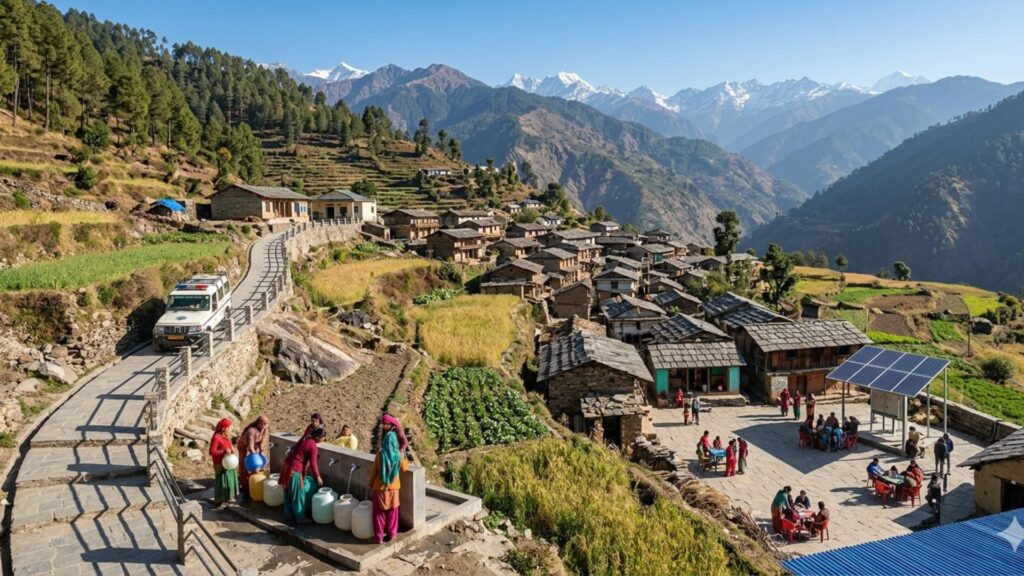
In Uttarakhand’s hill regions, naulas and dharas have historically shaped where and how villages exist. They ensured:
- reliable water access
- support for agriculture and livestock
- manageable daily effort for households
- continuity of habitation
These were not isolated resources—they were part of a functioning village system.
SYSTEM SHIFT
From Functioning Systems to System Decline
Across many last-mile Himalayan villages:
- Natural springs are weakening or disappearing
- Access remains limited to unsafe, narrow footpaths
- Agriculture is becoming increasingly unreliable
- Women carry a growing physical and time burden
- Emergency mobility remains severely constrained
As this system weakens:
- Livelihoods become unstable
- Male outmigration increases
- Women and elderly populations carry disproportionate burden
- Essential services become harder to access
These are not separate issues. They form an interconnected system of risk, as seen across remote settlements.
Over time, this leads to declining settlement viability.
CORE IDEA
Beyond Water: A System Perspective
Nauladhara does not refer to water alone.
It represents the minimum conditions required for a village to function:
- Safe and reliable access for movement
- Natural resource systems that support daily needs
- Viable livelihoods under local conditions
- Reduced physical burden on women
- Basic safety for children and elderly populations
When these systems function together, villages sustain.
When they weaken together, migration becomes inevitable.
MIGRATION REALITY
Migration as a System Outcome
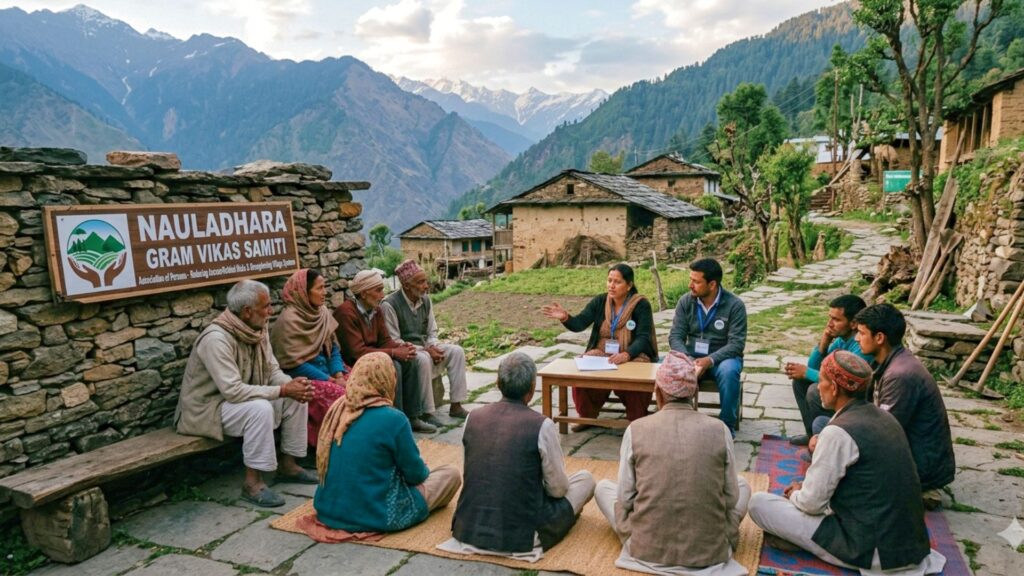
Outmigration in Himalayan regions is often viewed as an economic issue.
Field realities indicate otherwise.
Migration is frequently the result of:
- cumulative risk
- declining system reliability
- absence of safe access and mobility
- increasing effort required for basic survival
In this context, migration is not a choice—it is a response to system failure.
This is how villages gradually move toward abandonment.
INTERPRETATION
What “Nauladhara” Represents
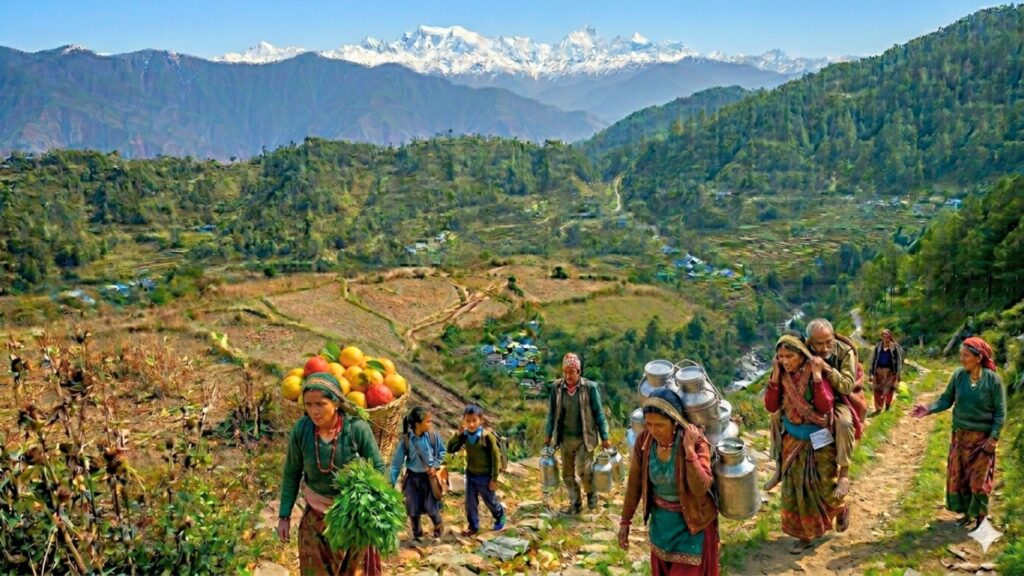
The term “Nauladhara” is used as a representation of a functioning village system.
It reflects a clear principle:
Village sustainability depends on the stability of interconnected systems—not isolated interventions.
This shifts the focus from sector-based solutions to system restoration.
IMPLEMENTATION LINK
What This Means in Practice
If village decline is driven by system failure, responses must also be systemic.
This requires:
- prioritizing access and mobility as a foundation
- stabilizing water and natural resource systems
- reducing risk in agriculture and livestock
- enabling women-led implementation through local groups
- ensuring convergence with government systems
This approach aligns with the phased, risk-first model used in implementation.
FIELD APPLICATION
From Concept to Ground
The Nauladhara concept is being applied through field implementation in villages such as Khitoli.
These locations reflect:
- lack of access
- dependence on natural springs
- high outmigration
- livelihood vulnerability
This allows the development of a replicable model for last-mile Himalayan settlements.
CONCLUSION
A Functional Village vs An Abandoned One
Nauladhara is not just a name.
It represents the difference between:
- a village that continues to function
- and a village that gradually becomes uninhabitable
The objective is not limited to development.
The objective is to restore the conditions required for villages to remain livable, stable, and sustainable over time.
WAY FORWARD
From Understanding to Implementation
If these systemic challenges reflect conditions in your area of work or interest, we invite you to engage with us in implementing structured, last-mile solutions for Himalayan villages.